
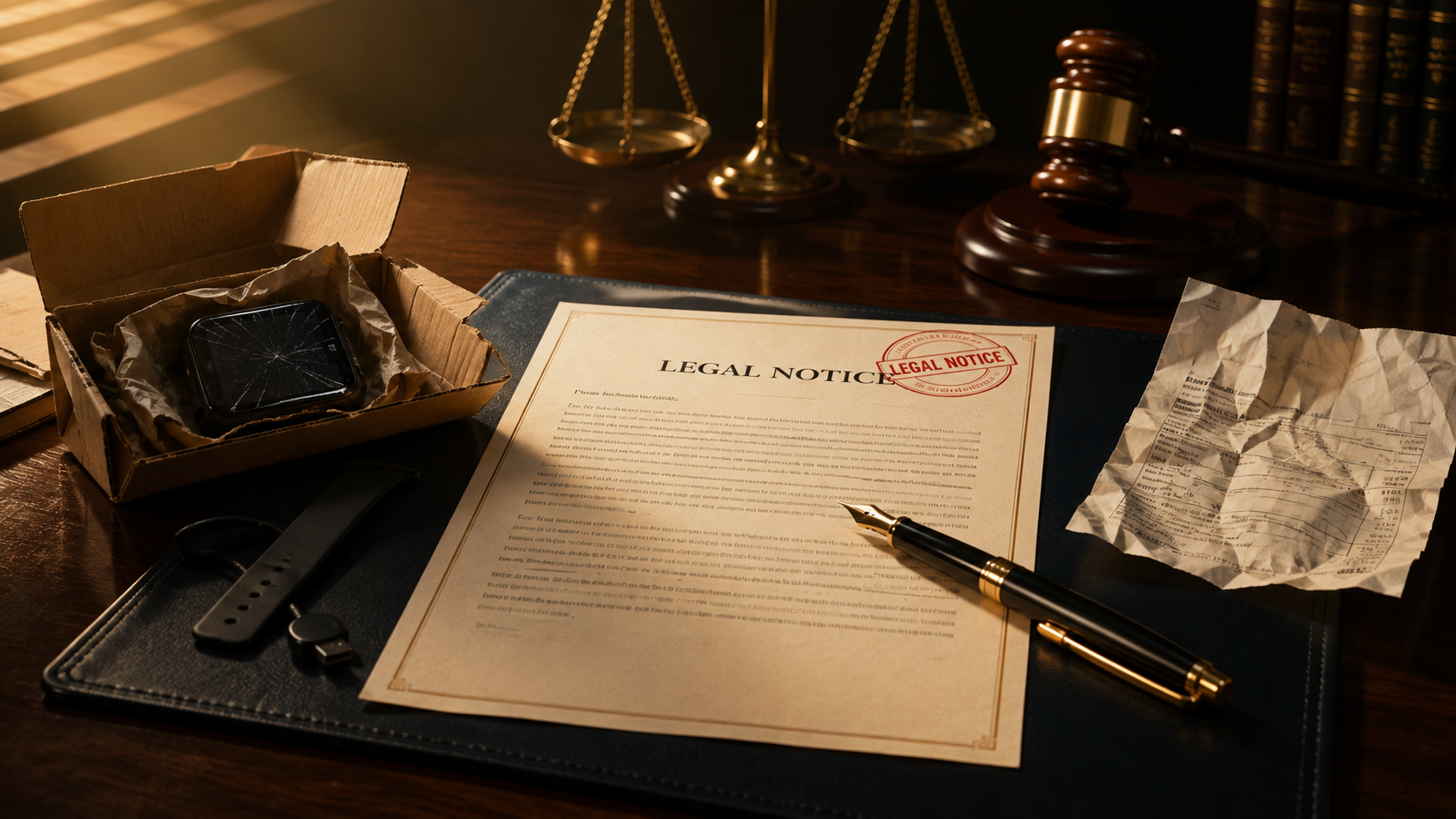
How to Send a Legal Notice for Consumer Complaint in India
Defective products, deficient services and e-commerce disputes — your rights and the notice that enforces them
Last Updated: March 2026 | Reading Time: 11 minutes
You bought a product that stopped working within weeks. You paid for a service that was never provided to you. A company charged you for something you never ordered. In all these situations, you have powerful legal rights under the Consumer Protection Act, 2019. Before delving into a legal battle, sending a legal notice for consumer complaint is the most effective first step to getting your money back or receiving the service you paid for. This guide explains exactly how to use the law to protect yourself as a consumer in India.
Your Rights Under the Consumer Protection Act, 2019
The Consumer Protection Act, 2019 (which replaced the erstwhile 1986 Act), significantly strengthened consumer rights in India and introduced several new protections. If you are an aggrieved consumer, you have the following legal rights:
Right to Safety: Protection against goods and services that are hazardous to life and property.
Right to Information: The right to be informed about the quality, quantity, potency, purity, standard, and price of goods or services.
Right to Choose: Access to a variety of goods and services at competitive prices.
Right to be Heard: Your grievances will be heard and considered at appropriate forums.
Right to Redressal: The right to seek redressal against unfair trade practices or restrictive trade practices or unscrupulous exploitation.
Right to Consumer Education: The right to acquire knowledge and skills to be an informed consumer.
The 2019 Act also introduced e-commerce regulations, product liability provisions, and the Central Consumer Protection Authority (CCPA) — making it significantly more powerful than its predecessor.
When Should You Send a Consumer Complaint Legal Notice?
A legal notice is appropriate in a wide range of consumer situations. The key is that you must be a “consumer” under the Act — meaning you purchased goods or services for personal use (not for commercial resale).
Defective Products
If a product you purchased is defective — meaning it has a manufacturing defect, design defect, or fails to conform to the specifications promised — you are entitled to a replacement, repair, or refund. Common examples include electronics that fail prematurely, appliances that don’t work as advertised, clothing that deteriorates rapidly, and food products that are adulterated or mislabelled.
Deficient Services
Service deficiency is one of the most common grounds for consumer complaints in India. This includes delayed or incomplete construction by builders, poor quality medical treatment i.e. medical negligence, deficient banking or insurance services, substandard hotel or restaurant services, and inadequate educational services.
Unfair Trade Practices
Unfair trade practices include false advertising, misleading price representations, offering gifts or prizes with the intent to deceive, and selling goods at prices higher than the MRP. If you’ve been misled into such a purchase, you have grounds for a consumer complaint.
E-Commerce Disputes
The 2019 Act specifically addresses e-commerce. If an online platform sold you a counterfeit product, failed to deliver your order, refused a legitimate return, or engaged in deceptive pricing, you can send a legal notice to both the seller and the platform.
The Legal Notice: Your First Step
Before filing a complaint with the Consumer Forum (now called the Consumer Commission), sending a legal notice to the company or service provider is strongly advisable and often leads to a faster resolution. Companies — particularly large ones — prefer to resolve consumer disputes quietly, and this saves you the legal costs and time you might otherwise incur in a full-fledged Consumer Commission proceeding. Further, if the situation arises, a legal notice serves as evidence demonstrating that the aggrieved consumer had previously approached the defaulting party, but the issue remained unresolved, thereby operating in your favour. Additionally, in the event the defaulting party responds by denying your claim, it provides valuable insight into their stance, enabling you to appropriately frame and strengthen your complaint.
What the Notice Must Contain
A consumer complaint legal notice must include the following elements:
Your Details: Full name, address, and contact information as the complainant-consumer.
Respondent’s Details: The company’s registered name, registered office address, and the name of the Managing Director or CEO (for larger companies).
Purchase Details: Date of purchase, invoice number, product/service description, amount paid, and mode of payment.
Nature of the Defect or Deficiency: A precise description of what went wrong — when the defect appeared, how it manifests, what attempts you made to resolve it with the company, and the company’s response (or lack thereof).
Legal Basis: Citation of the specific provisions of the Consumer Protection Act, 2019 under which you are making your claim.
Specific Demand: What you want — a replacement product, repair, full refund, compensation for losses suffered, legal costs, etc. Be specific about the amount you are claiming.
Timeline: Give the company 15 to 30 days to respond and resolve the matter.
Consequence of Non-Compliance: State clearly that you will file a complaint with the appropriate Consumer Commission if the matter is not resolved within the specified time.
Which Consumer Commission Has Jurisdiction?
Under the Consumer Protection Act, 2019, consumer complaints are filed with one of three levels of Consumer Commission based on the value of the claim:
| Commission | Jurisdiction | Where to File |
|---|---|---|
| District Consumer Commission | Claims up to ₹50 lakhs | District headquarters |
| State Consumer Commission | Claims from ₹50 lakhs to ₹2 crores | State capital |
| National Consumer Commission | Claims above ₹2 crores | New Delhi |
The limitation for sending the legal notice is 2 years from the date when the consumer becomes aggrieved, also known as the cause of action. The legal notice should be sent before filing with the appropriate Commission as per the said limitation. Further, mentioning the specific Commission you intend to approach in the notice adds weight to your demand.
Compensation You Can Claim
Under the Consumer Protection Act, 2019, you can claim compensation for:
- The cost of the defective product or deficient service
- Replacement of the defective product
- Repair costs
- Medical expenses incurred due to a defective product
- Mental agony and harassment caused by the deficiency
- Litigation costs
- Punitive damages in cases of gross negligence or wilful misconduct
The 2019 Act significantly increased the compensation amounts that Consumer Commissions can award, making consumer litigation more worthwhile than under the old Act.
Step-by-Step Process
Step 1: Document Everything. Gather all evidence — purchase receipts, invoices, warranty cards, photographs of the defect, screenshots of online orders, all correspondence with the company (emails, chat transcripts, complaint ticket numbers), and any medical reports if applicable.
Step 2: Attempt Internal Resolution. Before sending a legal notice, make a genuine attempt to resolve the matter through the company’s customer service. This demonstrates good faith and strengthens your position if the matter proceeds to the Consumer Commission. One may also approach the National Consumer Helpline (NCH) via consumerhelpline.gov.in or by calling 1915 for redressal of consumer grievances.
Step 3: Draft and Send the Legal Notice. Have a qualified advocate draft the notice on their letterhead. Send it by RPAD to the company’s registered office address. Also send a copy to the company’s customer service email address.
Step 4: Wait for the Response Period. Give the company the specified time (15–30 days) to respond. Many companies resolve complaints at this stage to avoid formal proceedings or harm to their goodwill and reputation.
Step 5: File with Consumer Commission if Needed. If the company fails to respond or refuses to resolve the matter, file a formal complaint with the appropriate Consumer Commission. The legal notice will form an important part of your complaint.
How Kaanuni Paramarsh Can Help
At Kaanuni Paramarsh, we draft legally precise consumer complaint notices that clearly establish your rights and demands under the Consumer Protection Act, 2019. Our AI-powered system creates a customised notice based on your specific situation, reviewed by a qualified advocate.
What you get:
- Customised consumer complaint legal notice
- Precise citation of Consumer Protection Act provisions
- Lawyer review and verification
- Guidance on the appropriate Consumer Commission
- Delivery within 24 hours
- Starting at ₹1,299
Get your money back. Assert your consumer rights today. Get Your Legal Notice →
Frequently Asked Questions
Q: Is a legal notice mandatory before filing a consumer complaint? A: It is not legally mandatory, but it is strongly advisable. A notice often resolves the matter faster than formal proceedings and demonstrates good faith to the Consumer Commission.
Q: How long does a consumer complaint take in India? A: Consumer Commission proceedings can take anywhere from a few months to a few years depending on the complexity of the case and the Commission’s workload. A legal notice that resolves the matter without formal proceedings is almost always faster.
Q: Can I file a consumer complaint against an e-commerce platform? A: Yes. Under the Consumer Protection (E-Commerce) Rules, 2020, e-commerce platforms have specific obligations to consumers. You can file complaints against both the seller and the platform.
Q: What is the time limit for filing a consumer complaint? A: Consumer complaints must be filed within 2 years of the date on which the cause of action arose (i.e., when the defect or deficiency occurred or was discovered). Sending a legal notice early preserves your rights.
Q: Can I claim compensation for mental agony in a consumer complaint? A: Yes. Consumer Commissions regularly award compensation for mental agony, harassment, and inconvenience caused by defective products or deficient services, in addition to the direct financial loss.
Related Guides
- How to Send a Legal Notice in India: Complete Step-by-Step Guide
- Cheque Bounce Case Under Section 138: Your Complete Legal Guide
- Legal Notice for Property Dispute in India: A Complete Guide
For personalised legal advice on your consumer complaint, Contact a Lawyer at Kaanuni Paramarsh today.