
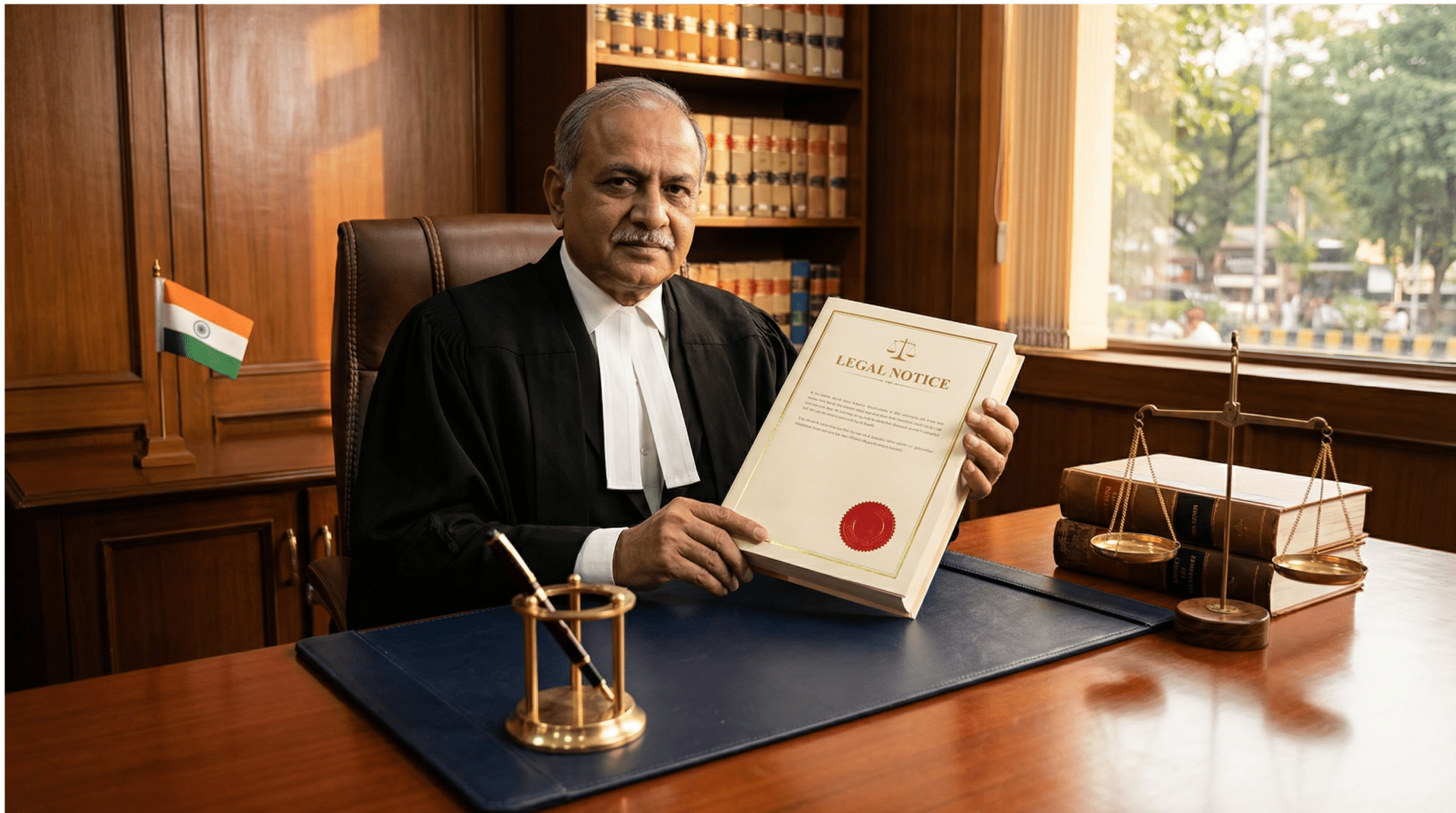
How to Send a Legal Notice in India: Complete Step-by-Step Guide
Format, Costs, Timeline, Legal Requirements, and What Happens After You Send One
What Is a Legal Notice?
A legal notice is a formal written communication sent by one party (the sender) to another party (the recipient), typically through an advocate, informing them of a grievance and demanding specific action within a stipulated time.
It serves as an official warning that legal proceedings may follow if the recipient fails to comply with the demands.
Think of a legal notice as the legal equivalent of a "final warning" — it's your way of telling someone:
"I'm serious about this matter, and I'm prepared to take you to court if you don't resolve it."
Key Characteristics of a Legal Notice
A valid legal notice in India typically includes several essential elements:
It must be sent on an advocate's letterhead with their enrollment number clearly mentioned.
It should contain complete names and addresses of both the sender and recipient.
The notice must clearly state:
Facts of the dispute
Legal grounds for the claim
Specific relief or action demanded
It should specify a reasonable time period for compliance (usually 15–30 days) and warn of legal consequences if the demand is not met.
When Should You Send a Legal Notice?
Understanding when to send a legal notice is crucial. There are situations where sending a notice is legally mandatory, and others where it's strongly advisable even if not required by law.
Mandatory Situations
Cheque Bounce Cases (Section 138)
If someone's cheque has bounced due to insufficient funds, you must send a legal notice within 30 days of receiving the bank's "cheque returned" memo.
This is a strict requirement under the Negotiable Instruments Act, 1881. Missing this deadline means losing your right to file a criminal case.
Suits Against Government
Before filing a civil suit against the Central or State Government, or any public officer, you must give a two-month notice under Section 80 of the Civil Procedure Code, 1908.
Specific Relief Act Cases
Certain cases seeking specific performance of contracts require prior notice.
Advisable Situations
Even when not legally mandatory, sending a legal notice is advisable in many situations:
Money recovery disputes
Employment disputes
Landlord-tenant disputes
Defamation cases
Breach of contract situations
The Legal Notice Format in India
A properly drafted legal notice follows a specific format that courts recognize and respect.
Using the correct format is essential for the notice to carry legal weight.
Standard Legal Notice Structure
Advocate's Letterhead
Includes name, enrollment number, address, and contact details.Date and Reference Number
Every notice should have a date and unique tracking reference.Recipient's Details
Full name and complete address of the recipient.Subject Line
Clearly indicating the nature of the notice.Salutation
Introduction
Identification of the sender and their relationship to the recipient.Factual Background
Chronological narration of facts.Legal Grounds
Applicable laws and provisions supporting the claim.Demand/Relief Sought
Clear statement of what action is required.Timeline for Compliance
Typically 15–30 days.Consequences of Non-Compliance
Warning of legal proceedings.Closing
Advocate’s signature and stamp.
How to Send a Legal Notice: Step-by-Step Process
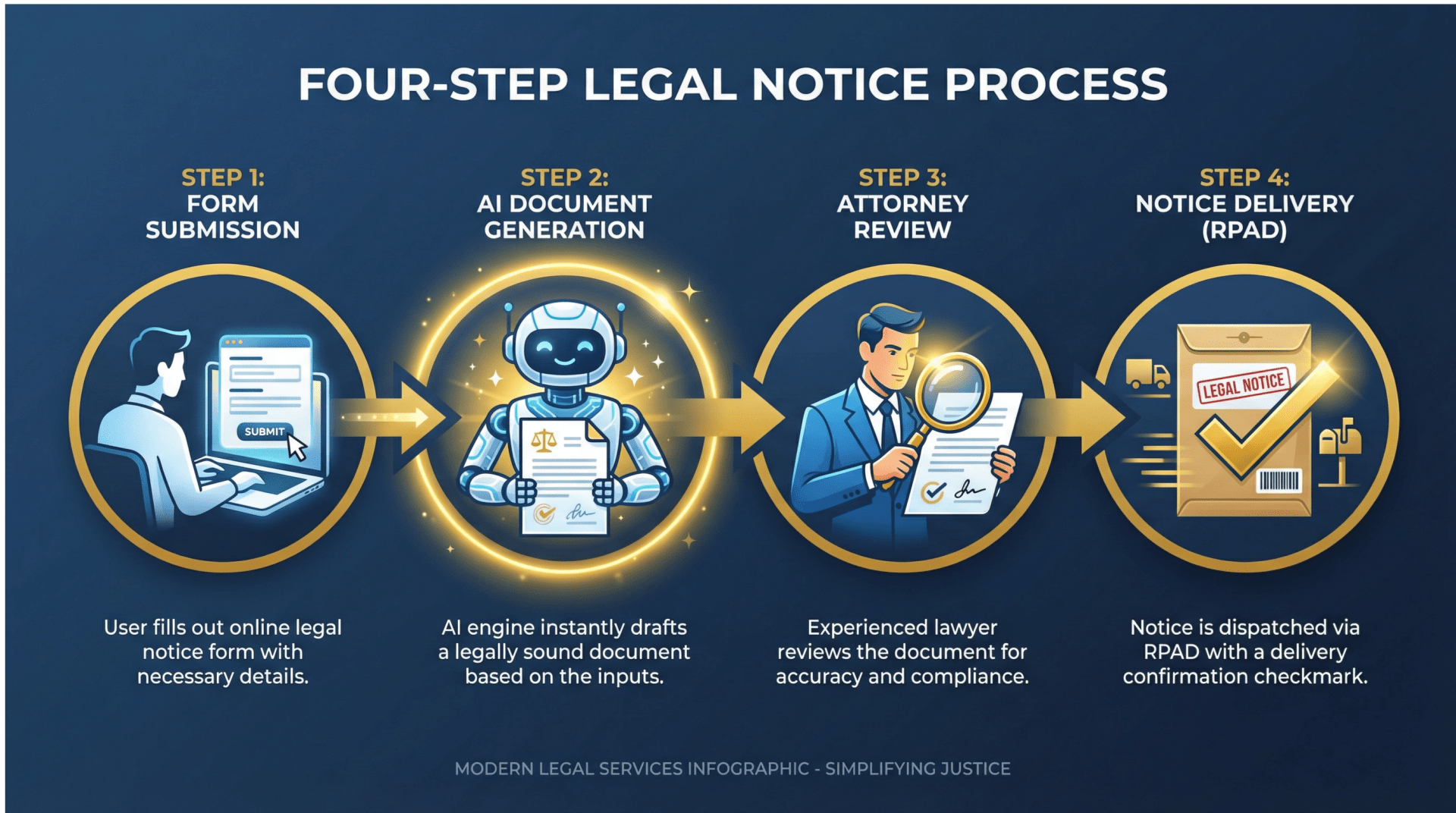
Step 1: Gather Your Documents
Collect all supporting evidence such as:
Contracts and agreements
Payment records
Emails/messages
Photos or videos
Witness statements
Step 2: Consult a Lawyer
A lawyer can:
Assess case strength
Identify legal provisions
Draft proper language
Advise on demands and timelines
Step 3: Draft the Notice
The lawyer prepares the draft based on your information. Review carefully for accuracy.
Step 4: Send via Registered Post (RPAD)
Standard method: Registered Post with Acknowledgment Due (RPAD).
Alternative methods include:
Speed Post
Courier
Hand delivery with acknowledgment
Email (as additional method)
Step 5: Wait for Response
The recipient may:
Comply
Send a reply notice
Request negotiation
Ignore the notice
Step 6: Decide Next Steps
Depending on the response, you may:
File a case
Negotiate settlement
Take other legal action
What Happens After Sending a Legal Notice?
Scenario 1: Recipient Complies
Dispute gets resolved without court involvement.
Scenario 2: Recipient Sends a Reply
Negotiation and settlement discussions may begin.
Scenario 3: Recipient Ignores Notice
You can proceed with legal action.
Scenario 4: Settlement Through Negotiation
Many disputes resolve at this stage.
Cost of Sending a Legal Notice in India
Traditional Lawyer Fees
Typically range between ₹1,500 to ₹10,000, depending on:
Case complexity
Lawyer experience
Location
Modern AI-Assisted Services
Services like Kaanuni Paramarsh can reduce costs to ₹500–₹2,500.
Additional Costs
RPAD postage: ₹50–₹100
Courier charges
Notarization (if required)
Common Mistakes to Avoid
Missing mandatory deadlines
Incorrect recipient address
Vague demands
Factual errors
Threatening language
Sending without legal advice
Frequently Asked Questions
Can I send a legal notice without a lawyer?
Yes, but a lawyer-sent notice carries more weight.
How long is a legal notice valid?
The notice itself doesn't expire, but the response period (usually 15–30 days) matters.
What if the recipient refuses to accept the notice?
Refusal itself serves as valid proof of attempted service.
Can a legal notice be sent via email?
Yes, but RPAD is still the safest primary method.
Is a legal notice the same as a court case?
No. It is a pre-litigation step.
Conclusion: Take Action with Confidence
Sending a legal notice is often the most effective first step in resolving a dispute. It demonstrates seriousness, creates a legal record, and often leads to settlement without litigation.
Whether dealing with unpaid dues, property disputes, employment issues, or other matters, understanding the proper process can significantly impact the outcome.
Ready to send your legal notice? Kaanuni Paramarsh offers AI-drafted, lawyer-verified notices starting at ₹500 with 24-hour delivery.
Related Guides
- Cheque Bounce Case Under Section 138: Your Complete Legal Guide
- Legal Notice for Non-Payment of Salary: Step-by-Step Guide
- Legal Notice for Property Dispute in India: A Complete Guide
Would you rather a lawyer drafted it for you? Get a lawyer-drafted legal notice →