

Employee Contract in India: Rights, Clauses & Legal Requirements
A Complete Legal Guide for Employers and Employees in India
Employee Contract in India: Rights, Clauses & Legal Requirements
An employment contract is a fundamental document that defines the relationship between an employer and employee. Yet many Indian businesses operate without formal written employment contracts, relying instead on verbal agreements or informal arrangements. This comprehensive guide explains everything you need to know about employee contracts in India, including legal requirements, essential clauses, employee rights, and how to create a contract that protects both employer and employee.
What Is an Employment Contract?
An employment contract (also called an employment agreement or service agreement) is a legally binding document that outlines the terms and conditions of employment between an employer and an employee. It specifies the employee's role, responsibilities, compensation, benefits, working hours, and other conditions of employment.
An employment contract serves multiple purposes: it clarifies the employer's expectations and the employee's responsibilities, it protects both parties by establishing clear terms, it provides legal recourse if either party violates the agreement, it helps prevent misunderstandings about salary, benefits, and working conditions, and it demonstrates professionalism and organizational structure.
Legal Requirements for Employment Contracts in India
Is an Employment Contract Mandatory?
In India, there's no absolute legal requirement for a written employment contract. However, certain laws mandate specific information to be provided to employees:
The Industrial Disputes Act, requires employers to maintain records of employment terms for workers. The Payment of Gratuity Act, requires employers to provide information about gratuity eligibility. The Shops and Establishments Act (varies by state) requires written employment terms in many cases. The Code on Wages, requires employers to provide wage-related information to employees.
While a formal contract isn't always legally mandatory, it's highly recommended for several reasons: it protects the employer from disputes about employment terms, it protects the employee by documenting their rights, it demonstrates compliance with labor laws, and it provides clarity for both parties.
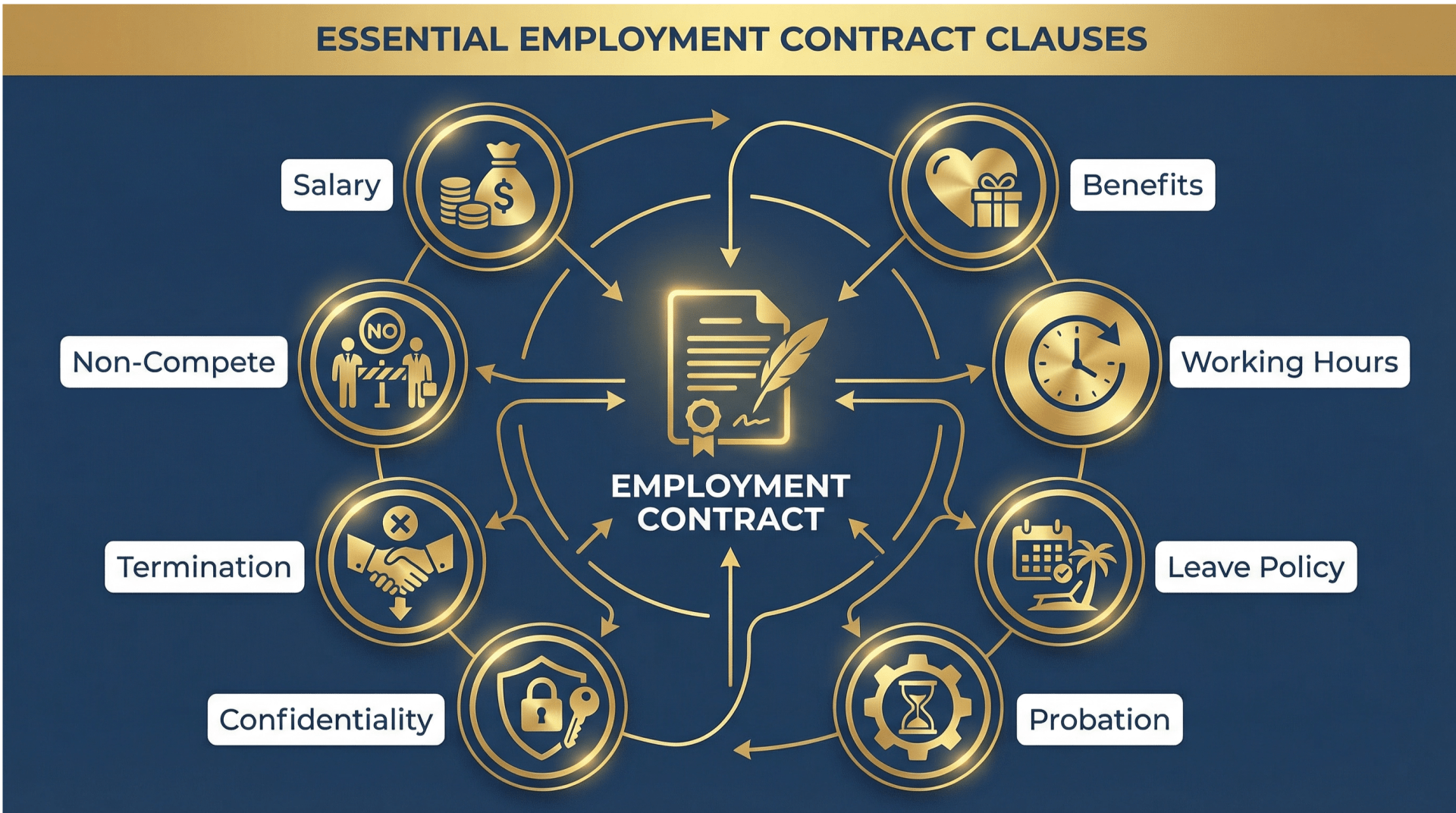
Essential Clauses in an Employment Contract
Parties to the Agreement
Clearly identify the employer (company name, registration details) and the employee (full name, address, contact details, PAN/Aadhar).Position and Responsibilities
Specify the job title, department, reporting structure, and detailed job responsibilities. Include the location of work and any provisions for remote work or relocation.Compensation and Benefits
Detail the salary structure including basic salary, allowances, and deductions. Specify the payment frequency (monthly, bi-weekly, etc.), payment method (bank transfer, cheque, etc.), and any performance-based bonuses or incentives. Include information about benefits such as health insurance, provident fund, gratuity, and leave entitlements.Working Hours and Leave
Specify the standard working hours (typically - hours per day, - days per week). Detail leave entitlements including casual leave, sick leave, earned leave, and special leaves. Include provisions for leave encashment and carryover policies.Probation Period
If applicable, specify the probation period (typically - months), the evaluation criteria, and the conditions for confirmation or termination during probation.Confidentiality and Non-Disclosure
Include clauses protecting the employer's confidential information, trade secrets, client lists, and business strategies. Specify what information is considered confidential and the employee's obligations to maintain confidentiality even after employment ends.Non-Compete and Non-Solicitation
Include clauses restricting the employee from working for competitors or soliciting clients/employees of the company during employment and for a specified period after employment ends (typically months to years). However, courts often view restrictive covenants skeptically, so they must be reasonable in scope and duration.Termination and Notice Period
Specify the notice period required for either party to terminate employment (typically - days). Include grounds for termination without notice (gross misconduct, repeated violations, etc.) and any severance or compensation due upon termination.
Employee Rights Under Indian Labor Laws
Statutory Minimum Wage
Employees are entitled to at least the minimum wage prescribed by the government for their state and industry. The contract cannot specify a salary below the minimum wage.Working Hours Limit
Under the Factories Act and Shops and Establishments Act, the maximum working hours are typically hours per day and hours per week. Overtime must be compensated at a higher rate.Leave Entitlements
Employees are entitled to paid leave as per statutory requirements:
Casual Leave: Typically - days per year
Sick Leave: Typically - days per year
Earned Leave (Annual Leave): Typically - days per year
Maternity Leave: weeks for women
Paternity Leave: days (varies by company)
Bereavement Leave: - days for death of family membersProvident Fund (PF)
Employers must contribute to the Employee Provident Fund (EPF) for employees earning up to ₹, per month (or higher in some cases). The employee and employer each contribute % of the basic salary.Gratuity
Gratuity Employees are entitled to gratuity after completing years of continuous service. The amount is calculated as (last drawn salary × number of years of service).Health and Safety
Employers must provide a safe working environment, proper equipment, and health insurance or medical facilities as required by law.Protection Against Unfair Dismissal
Under the Industrial Disputes Act, employers cannot dismiss employees without valid reasons and proper procedure. Unfair dismissal can result in reinstatement and compensation.
Types of Employment Contracts
Permanent/Full-Time Employment
The employee is hired for an indefinite period. Either party can terminate with the specified notice period. This is the most common form of employment.Fixed-Term Employment
The employee is hired for a specific period (e.g., year, years). The contract automatically ends on the specified date unless renewed.Temporary Employment
The employee is hired for a specific project or seasonal work. Employment ends when the project is completed or the season ends.Probationary Employment
The employee is hired on probation for a specified period (typically - months). Confirmation depends on satisfactory performance.Freelance/Contract Employment
The individual is hired for specific deliverables or services, not as a regular employee. This arrangement involves fewer statutory obligations.Internship
The individual is hired for a limited period to gain experience. Interns may have different rights and compensation than regular employees.
Common Mistakes in Employment Contracts
Salary Below Minimum Wage
Any contract specifying a salary below the statutory minimum wage is void. Always ensure compliance with minimum wage laws.Excessive Restrictive Covenants
Non-compete clauses that are too broad or too long may be unenforceable. Courts typically allow reasonable restrictions (e.g., - months, within the same city/industry).Unclear Job Description
Vague job descriptions lead to disputes about responsibilities. Be specific about duties, reporting structure, and performance expectations.Missing Statutory Information
Failing to include information about leave, gratuity, PF, and other statutory benefits can result in legal violations.One-Sided Terms
Contracts that heavily favor the employer and ignore employee rights are more likely to be challenged or unenforceable.No Clarity on Termination
Ambiguous termination clauses lead to disputes. Clearly specify notice periods, grounds for termination, and severance provisions.Creating Your Employment Contract
Option : Use Government Templates
The Ministry of Labour provides model employment contracts. However, these may not be customized for your specific industry or company.
Option : Hire a Labor Lawyer
Labor lawyers typically charge ₹999 for drafting an employment contract. They provide customized contracts compliant with all labor laws.
Option : AI-Assisted Services
Services like Kaanuni Paramarsh offer AI-drafted employment contracts starting at ₹999 with lawyer verification to ensure legal compliance, customization for your industry and company, and -hour delivery.
Frequently Asked Questions
Q: Is an employment contract mandatory in India?
While not always legally mandatory, it's highly recommended. Many labor laws require employers to provide specific information to employees, which is best documented in a contract.
Q: Can an employer change the contract terms unilaterally?
No. Any changes to the contract must be agreed upon by both parties in writing. Unilateral changes may be challenged as unfair.
Q: What if the employee refuses to sign the contract?
The employer can make signing the contract a condition of employment. However, the contract terms must be reasonable and compliant with labor laws.
Q: Can an employee be terminated during probation without notice?
During probation, employers typically have more flexibility, but they must still follow fair procedures. Termination without valid reason may be challenged.
Q: Are non-compete clauses enforceable in India?
Non-compete clauses are enforceable only if they're reasonable in scope, duration, and geography. Overly broad restrictions are typically unenforceable.
Conclusion
An employment contract is essential for establishing a clear, professional relationship between employers and employees. It protects both parties, ensures compliance with labor laws, and provides a foundation for resolving disputes.
Ready to create your employment contract? Kaanuni Paramarsh offers professionally drafted, lawyer-verified employment contracts starting at ₹999, with instant download and customization options.
This blog post is for informational purposes only and does not constitute legal advice. Laws may vary by jurisdiction and state. Always consult with a qualified legal professional for specific guidance on your situation.
Related Guides
- Offer Letter Format in India: Legal Requirements & Best Practices
- Startup Employee Contracts in India: What Every Founder Must Know
- NDA Agreement in India: When and How to Use Non-Disclosure Agreements
Hiring, and need contracts that protect the business? Get a lawyer-reviewed employment contract →